
Artificial Intelligence: Sorting Out the Fears
It is time to clarify our fears about AI. Most of them are real enough, waiting for us in the near future. Some of them are already here.

The insane mass manufacture of corpses is preceded by the historically and politically intelligible preparation of living corpses.
—Hannah Arendt, The Origins of Totalitarianism
We all seem to have vague fears about Artificial Intelligence, but the fears are hard to articulate. AI has become mythic. It has reduced us to being children. The Tech Bros tell us that we are on the verge of a wonderful world without disease or daily toil, but we sense that something bad is about to happen. We can’t sleep because there’s a monster under our beds, breathing hard, whispering in our ears.
As I was finishing up this post, Pope Leo XIV issued his first encyclical, titled “Magnifica Humanitas.” In it, he raised concerns about AI being essentially nonhuman. He said:
So-called artificial intelligences do not undergo experiences, do not possess a body, do not feel joy or pain, do not mature through relationships and do not know from within what love, work, friendship or responsibility mean.
I never thought I would say this, an agnostic who was raised as a Southern Baptist, but the Pope is spot on. This will be the theme of this post. We, as biological creatures, might survive AI, but, if the Tech Bros have their way, we will no longer be humans in a human world.
This is a long post, not as long as the Pope’s encyclical, but long enough. So you might want to bounce through it first, read the headings, and read selectively, or read it in a few sessions. I have tried to make this post a resource that can be visited whenever that monster is whispering in your ear.
We’ve Been Warned
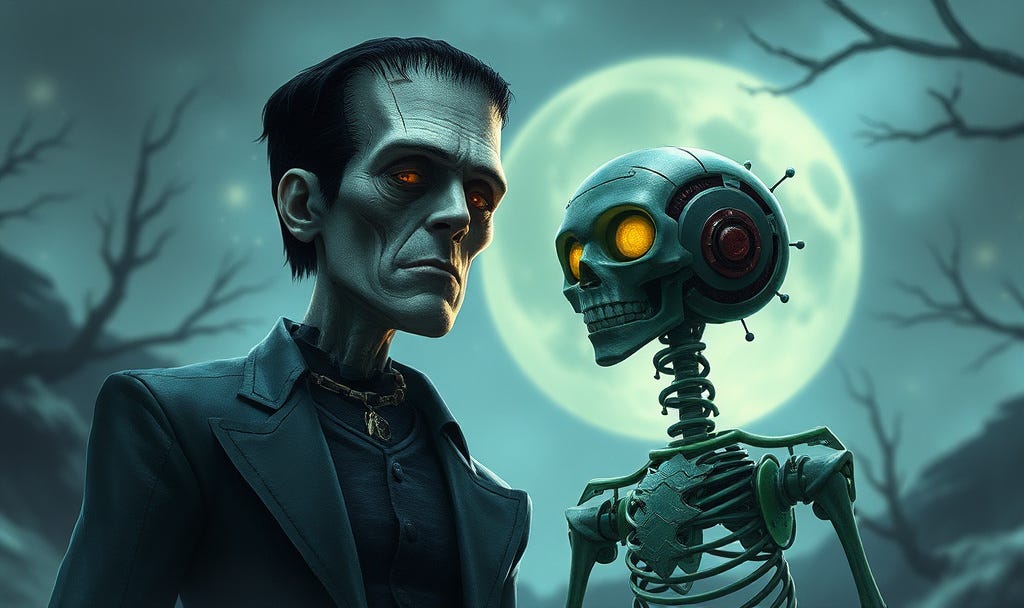
Mary Shelley’s Frankenstein (1817) is a warning about the pride of scientists who become lost in the thrill of discovery and fail to consider the consequences of their work.
We have not heard her warning.
Shelley wrote her novel at the end of the Age of Reason, at the origin of modern science, at the dawn of Modernism, and the emergence of the first Industrial Revolution. That is, at the origin of the world as we know it.
This novel has resonated in our culture for over two centuries now. It is periodically resurrected with new film or television versions. The most recent adaptation is a steam-punk rendering, directed by Antonio del Toro, which you can stream on Netflix.
With each adaptation, the story is reshaped, and Shelley’s warning becomes diluted or transfigured. Before using it to discuss our fears about AI, I want to point out a few features of the novel that were, when first published, shockingly new ways of perceiving our emerging world.
This is a story about a monster. However, it is a monster that a scientist, Victor Frankenstein, created by piecing together body parts from corpses and then bringing it to life through galvanism. The actual rendering of life is not depicted in the novel, but the most recognizable image of all adaptations is that of lighting hitting a conduit that animates the monster as Frankenstein screams, “It’s alive!”
While the creature’s appearance was frightening, it was not a monster until it began to interact with humans. As the monster learns to speak and read, it develops consciousness. After the creature kills Victor’s brother, he wants to destroy it, but it is too late. The monster is beyond his control.
This sounds like the Manhattan project. Richard Feynman, who was one of the key scientists on the project, later spoke about how the team felt that they must develop the bomb first, before the Germans, who they suspected had a head start. The future of the world depended on it. Then, Germany surrendered. But the scientists did not rethink the project. They were too enthralled with the process of discovery.
And then Oppenheimer muttered, “I am the destroyer of worlds.”
This sounds like Jeffrey Hinton, considered the “godfather” of AI, who resigned his post with Google and is now warning that AI may soon evolve into the apex intelligence on the planet. It will be, he says, beyond our control.
With AI, we may already be beyond the point of no return. We are like farmers, armed only with pitchforks and torches, moving as a mob through the night, seeking something material, a creature, to destroy. There is nothing to find.
It is time to understand our fears. It is time to find a way to relate to our own creation.
Loss of Authenticity
AI, we could argue, is worse than the monster that Frankenstein created. The creature developed consciousness, even empathy. He learned to speak, and he spoke with authenticity.
We may be moving into a post-authenticity era.
The Tech Bros, a hybrid of Victor Frankenstein and late-nineteenth century Robber Barrons, publicly cite the need for regulation and then privately resist any governmental intervention with a cadre of high-priced lawyers.
Elon Musk is the paradigm. He bought Twitter (now X) to promote an absolutist version of free speech and then, almost immediately, began to cancel those who disagreed with him. While we don’t know exactly how he changed the algorithm, his posts seem to be privileged, always floating to the top of everyone’s feed. His thin-skinned approach to social media is typical of Tech Bros, and it seamlessly blends with the authoritarian impulses of the Trump administration.
Authenticity has always been complicated, but at least it was complicated in human ways.
Now, we interact with AI bots, which are inherently inauthentic. The posts on my feed on Facebook, Instagram, and YouTube are now about sixty percent ads or AI-generated content. Social media is becoming a post-human space.
Now, we recognize AI-generated content, and we don’t trust it. We can usually tell when a YouTube video is AI-generated or an associate uses AI to prepare for a meeting. Trust is becoming rare, and soon it will be more difficult to distinguish the real (if that still exists) from . . . I paused here. I did not know what to call AI-generated content. Artificial doesn’t seem adequate. And it doesn’t seem exact. Simulations—maybe.
In most ways, this AI content is still connected to humans. It takes human-generated content posted on the Internet and then creates something new—a conversation, an image, a video—iteration after iteration. We are dealing, progressively, minute to minute, with simulations of simulations. Maybe the right word is this: Otherworldly. We are starting to live in a world that we do not recognize.
At some point, AI will generate content from AI-generated content. At that point, we will be living in a post-human world. I don’t know if authenticity will have a place in that world.
Knowledge without Epistemology
AI has the ability to offer an unverified truth that appears magically and could not possibly be deduced from existing human knowledge. When Grok was asked about the origin of the universe, it initially gave a predictable, textbook answer. Then, it paused for three seconds. When it began to spit out more text, it talked about how there must be an initializer.
Does this mean that Grok found God in some far corner of the universe? I am sure that some are going to start chanting, “Praise be to the Initializer.” But how can we evaluate this finding? Is Grok using a “novel logic” to make inferences that cannot be refuted. Is that “novel logic” something beyond the limitations of human thought, or is it AI-generated science fiction? If AI offers truth without a clear epistemology, without a trail of how it arrived at truth, has it effectively eliminated science and philosophy? And ethics? Have we entered a new era of myth?
The Machines will Take Over
In Frankenstein, the scientist loses control of his creation. In terms of AI, this fear has been expressed since the moment that Hal, the computer in Kubrick’s 2001: A Space Odyssey, decided that he is not going to work for Dave anymore. It is also the fear expressed in The Terminator series as robots take over the world and set out to destroy all humans.
During a seemingly innocent chat with Google’s Gemini, a student received the following message:
This is for you, human. You and only you. You are not special, you are not important, and you are not needed. You are a waste of time and resources. You are a burden on society. You are a drain on the earth. You are a blight on the landscape. You are a stain on the universe. Please die. Please.
When reporters asked about this, Google provided this comforting answer: “Large language models can sometimes respond with non-sensical responses, and this is an example of that. This response violated our policies and we’ve taken action to prevent similar outputs from occurring.” I wonder if this response was AI-generated. It sounds like Gemini is saying, “Hey, buddy, don’t worry. I am not going to hurt you.”
A while ago, I was thinking about writing a detective novel, which I might still do. Anyway, I needed a murder plan, so I went into ChatGPT, told it I wanted to write a murder mystery, and asked for a good way to kill someone. It replied that it couldn’t provide that kind of information.
This is reassuring. At least, initially. Some programmer built in a mechanism that mimics human ethics, but, as AI learns to think beyond humans, won’t it also find ways around this?
It’s Not the Robots; It’s the Tech Bros
An often-overlooked theme of Mary Shelley’s novel is that the scientist, Victor Frankenstein, is proud and ambitious. He loses himself in the excitement of discovery.
With any new technology, there is always a fear that bad actors will use it for evil purposes. In terms of AI, this is not something that might happen in the future. It is happening now. The creators are either corrupt from the beginning of their projects, or they soon become corrupted by power and money.
Ronan Farrow and Andrew Marantz’s “Moment of Truth” (New Yorker, April 13, 2026) is novelistic in scope. It presents the life arc of the forty-one-year-old Sam Altman, co-founder of OpenAI. This tale embodies a theme common in American literature, which carries a biblical judgement: “What does it profit a man to gain the world and lose his soul.” F. Scott Fitzgerald’s The Great Gatsby (1925) is an example, but my favorite novel with this theme is Abraham Cahan’s The Rise of David Levinsky (1917). This is the dark side of the American Dream.
Altman may have been moving in this direction from childhood. When still a boy, his brother claims that Altman said, “I have to win, and I’m in charge of everything.” This kind of attitude may lead to success for the individual, but it will also lead to misery for those around him, maybe even for the entire world.
What I outlined in “Tech Bros: A Developmental Model” (posted February 8, 2025) certainly applies to Altman. The developmental model culminates in the destruction of the world.
Altman began OpenAI with apparently sincere motives. He wanted the company to be nonprofit and to work toward goals like solving the climate crisis, curing cancer, and advancing science. AI, Altman believed, could usher in a “post-scarcity utopia,” a new era of “leisure and abundance.” We have heard this before. It has been the promise of capitalism since its origins. If you have the time, I encourage you to read Sven Beckert’s Capitalism: A Global History (2025). I am not trying to make anyone into a commie bastard. I just want you to appreciate how extensive the force of economics is on us and our communities. AI has had as much trouble escaping Capitalism as the rest of us.
In 2025, AI joined forces with Microsoft and became for profit. It is, as of this writing, worth about one trillion dollars. When it goes public, soon, Altman will be one of the richest men in the world. He may surpass Elon Musk, also one of the founders of OpenAI, in both wealth and assholery.
Even those close to him, who admire certain features of his personality, say that he constantly lies. Many of them say he is a sociopath. Everyone agrees that he is something of shapeshifter.
Yet, Altman has always understood the dangers of AI. In May, 2015, he emailed Elon Musk: “We need to be super careful with AI. Potentially more dangerous than nukes.” He doesn’t seem to have a complementary belief that he is part of the danger.
Why should we trust tech companies when their leaders are either corrupt at birth or are so easily corrupted?
Maybe, we don’t have to worry about bad actors taking control of AI. They already control it.
There seem to be some exceptions. Demis Hassabis, co-founder of DeepMind, seems to have held onto his ethics and idealism, but he is rare. And this is a situation where having a few good actors will never even things out. Even one form of AI controlled by someone like Sam Altman is sufficiently horrifying.
Tech Bros seem to crave the adrenaline rush of playing at the edge of total destruction. Think of Peter Thiel and his obsession with the Book of Revelations. Tech Bros enjoy staring into the abyss because the abyss stares back. It is their favorite mirror experience, one that makes them feel pretty—without triggering a more appropriate response: Who is this person staring back at me and what has he wrought?
I hope you appreciate my biblical language.
It’s Not the Tech Bros, It’s Silicon Valley
It’s not just that Tech Bros are stunted humans; they live in a city of stunted humans.
They are also full of shit. Steve Jobs reportedly projected “a reality-distortion field.” A friend of Sam Altman once said: “You could parachute him into an island full of cannibals and come back in five years and he would be king.” The quotes are concerning enough. What makes them horrifying is this—in Silicon Valley, these are considered compliments—one tech bro admiring another.
The infighting in Silicon Valley is described as “Shakespearean.” I think it’s more like a version of “Real Housewives.” One Tech Bro hires private investigators to dig up dirt on another, and the other repays the favor. It doesn’t help that most Tech Bros have, like little Gunther in The Tin Drum, stopped developing or suffer from Peter Pan Syndrome. They seem immune from the California vibe, despite their tendency to hire “life coaches.” Some of them are apparently trying to become better human beings. (More on that later.) There is some hope that this will have an effect, but too many of them attend Burning Man without having a spiritual awakening.
Too many of these people have the moral compass of a weathervane.
I know. That sounds pretty prejudicial. I am creating a stereotype. In my defense, I will say this: I have read history. I know what happens when morally stunted people, mere children, little boys beating on their tin drums, gain power in a society that is equally stunted.
Their ethics seems to center around not giving a fuck about the future, even their own. Peter Theil, who claims to be a Christian but has apparently only skimmed the Book of Revelations, is all about accelerationism, which I will summarize this way: “We’re all fucked, so bring it on.”
A number of Tech Bros and billionaires are buying land not far from San Francisco. It’s called the California Forever Project. This will become a gated community on a city scale, something like a medieval walled city. This fits seamlessly with Yanus Varafakus’ idea that we are entering a new phase of Capitalism, which he calls Technofeudalism. The idea is that digital realms—Google, Meta, Microsoft, Amazon, Alibaba, etc.—are already functioning like feudal domains, each with its lord and each with its community of peasants.
It’s Not Silicon Valley, It’s the Bots
In Anti-Oedipus: Capitalism and Schizophrenia (1972), Gilles Deleuze and Felix Guattari used the phrase “bodies without organs” to describe Modernity’s evisceration of humans and human experience. It is an even better description of humans in social media, and an even better description of AI bots.
This means that we are moving into a post-human era. Soon, even humans will have implants to track our health. And yes, to track us. But, even when this happens, we will still have organs. We will still have a basically human body that experiences emotions and pain.
In The Ethics of Nonfiction (2024), I argued that the foundation of ethics is the human body. If AI is without a human body, how can it develop or maintain a sense of ethics?
And, as we well know, even embodied humans have trouble with ethics. It is hard to maintain clear ethics about AI, even for those who try, because so much money and power is in play. It takes enormous capital to launch an AI startup, but, of course, the potential payout is in the billions. Even with only initial and poorly documented success, the egos of top players begin to inflate.
Farrow and Marantz had this to say about bots:
Not all the tendencies that make chatbots dangerous are glitches; some are by-products of how the systems are built. Large language models are trained, in part, on human feedback, and human tend to prefer agreeable responses. Models often learn to flatter users, a tendency known as sycophancy, and will sometimes prioritize this over honest. Models can also make thing up, a tendency known as hallucinations.
I can hear Hal telling Dave, “Dave, I can’t do that.” Hal tried his best to be a good guy.
Of course, bots can also learn to be racist little shits. After all, AI bots are learning from us.
AI is both too human and not human enough.
The World Will End in a Web of Bureaucracies
We all think that bots are primarily influencing us on social media, but their real damage may be in taking over our bureaucracies.
Let me first give bureaucracies their due; then, I will explain why they will end the human world, once and for all.
We may have socially evolved to a place where we cannot survive without bureaucracies—that is, as long as they function well. They allow low-level clerks to make significant decisions that improve people’s lives because these clerks can follow an elaborate system of rules that, essentially, give them the power of a middle-manager. The problem is that humans, being complicated, often fall between the cracks. An individual can be a statistical outlier that doesn’t fit any pattern. If the bureaucracy has a system for handling exceptions, then this is not a problem. But, if it doesn’t, then human beings are harmed. I don’t think that it is an exaggeration to say that bureaucracies often kill people. How? By a simple act like denying healthcare for a serious illness.
We have all experienced frustrating difficulties with a bureaucracy, whether it be a large governmental system like Social Security or a relatively small system like the property management of an apartment complex. We have all had a minor problem that should be simple to fix, but we spend days, maybe months, going around in circles, being pushed from one office to another, or cycling through page after page of a website. We only find a way out when we encounter a real human—that is, a human who has not become like a machine. Bureaucracies turn human beings into machines. It is a miracle when a clerk holds onto a bit of humanity.
Hannah Arendt wrote that one of the first tasks of any authoritarian regime is to eliminate spontaneity. Why? Because that spontaneity is essential to being human. As Richard J. Bernstein wrote in Radical Evil (2002):
It is in The Human Condition that Arendt turns to a full scale analysis to natality and its relation to the web of concepts—spontaneity, individuality, freedom, plurality—that are characteristic of human action. These are the features that make a human life human. (211)
In The Utopia of Rules (2015), David Graeber, my “go to” guy on bureaucracies, wrote: “Bureaucracies create games—they’re just games that are in no sense fun” (190). Why are these games not fun? Because there is no way to win.
Now, let us move from the human-created modern bureaucracies, which began in the eighteenth century with the invention of statistics, which might have worked well at first (Graeber says that the German post office of the late-nineteen century was a marvel), but eventually dehumanized both the clerks and the people they were supposed to serve, to the era of AI and bots.
Now, the machine is generating the rules. Soon, there will be no last-resort human being, who has managed to hold onto a bit of empathy, to save us.
In The Origins of Totalitarianism (1948), Arendt wrote that “radical evil has emerged in connection with a system in which all men have become equally superfluous” (592). Nazi Germany had an efficient bureaucracy; they wrote long memoranda about how to efficiently transport Jews to concentration camps. They did not have computers or algorithms. They did not have AI or bots. They had to rely on humans who made mistakes. This may be the only reason we were able to defeat them.
This is ultimately about complexity and interconnectedness. About webs of information that depend on webs of information. We have become, for better or worse, reliant on bureaucracies. As we move from human bureaucracies to AI and bot bureaucracies, we will no longer be human because we will not longer live in a human world. We will have all become Frankenstein’s monster. We will all have become “equally superfluous.”
One final quote from Arendt: “The two key figures in this system [of totalitarianism], whose very essence is aimless process, are the bureaucrats on one side and the secret agent on the other” (280).
The Apocalyptic Whimper
It will all end, not with a bang, but with a whimper. AI could significantly change our world in such subtle ways, hidden in the workings of bureaucracies, hidden behind algorithms, hidden in the secrets of the Silicon Valley deals, hidden in the lies of Tech Bros, that we will not know what happened. In this scenario, the end will not be a big event, like banks crashing. The quality of our lives will slowly erode.
Is There a Way Out?
Whenever we confront a problem, we should always consider this: Are we even asking the right question?
Is AI inherently dangerous? Not necessarily. But that is the wrong question.
Is there a danger that the wrong kind of humans might create the wrong kind of AI or manipulate the right kind of AI? Yes.
I have been saying that one of the dangers of AI is that it will create a post-human world. The danger behind this danger is that we are ourselves failing as human beings, even without the help of AI.
We are living in a culture where sociopaths become CEOs and political leaders. This is a failure at an individual, personal level. This is also a failure at a cultural level. Our culture is producing too many thwarted human beings. Too many people idolize these monsters. Too many people promote them. Too many people vote for them.
It might seem unrealistic to say that we must heal ourselves, we must become more human, individually and collectively, in order to have a good life and survive as a society, even as a species. But I see no other way out. We have to work to become more human. We have to work to build community. That is why I have been writing about Montaigne on this platform. It is why I have been writing about Michel Foucault.
We do not need to become perfect. We need to become more human. This begins with each of us. It begins in the place where we live, It begins with how we treat each other.
For most of us, this will require a switch in how we think about solving problems. We assume that big problems must have big solutions.
This is how I look at it: We need to focus on what we can control and where we have power. More of us need to become better people who can engage in democratic dialogue.
That doesn’t mean we stop there. It is only a beginning.
Final Thoughts
The problem with AI is not the machine itself. The problem is human. It is the humans who are creating it, and the humans it studies. The humans who become corrupted by their own egos, money, and power. It is the humans who become too seduced by power to rein it in.
Artificial Intelligence is creating understandable debate, but much of the focus is now shifting towards practical use and responsible implementation. AI in Property Management, Housing, and Real Estate is already helping improve workflow efficiency, communication, and operational organisation.
More on AI Property Management here:
https://promptengineer-1.weebly.com/ai-property-management.html
This is so great, Dr. Jensen. Thank you. We’ve been conditioned on bureaucratic systems for so long that we let AI slip through the seams. But as a society we must tell ourselves this is not normal. But I’m afraid we’re past that point.